
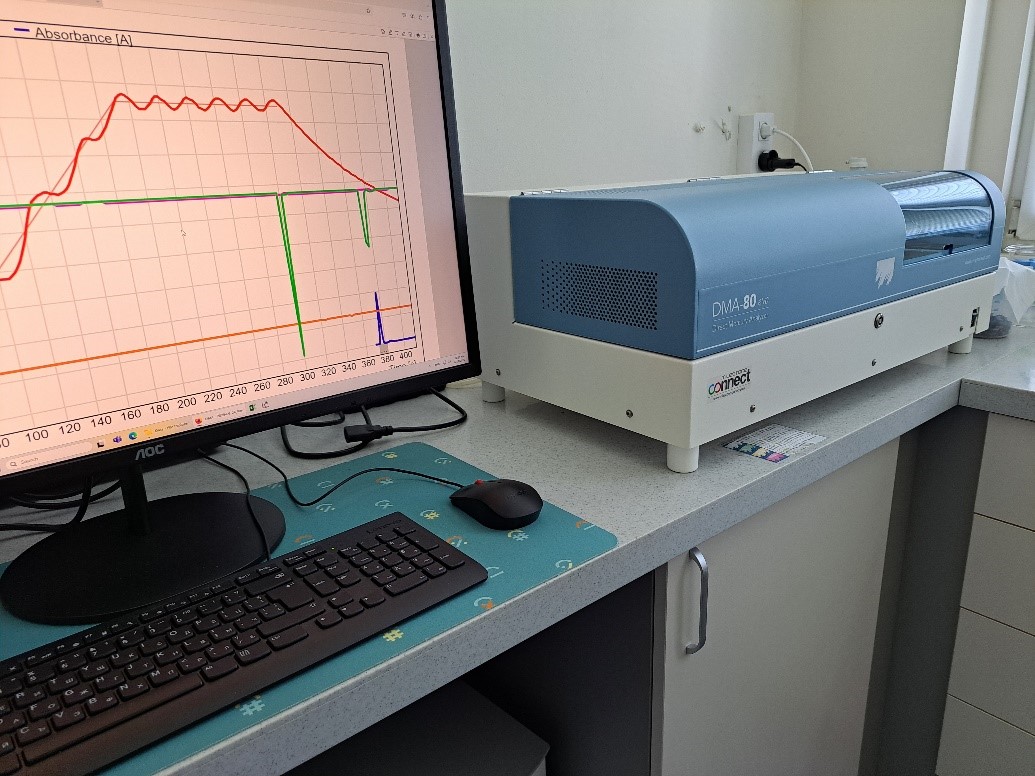
The direct mercury analyzer operates on the principle of thermal decomposition, amalgamation, and registration of mercury content in liquid, solid, or gaseous samples by atomic absorption. It is distinguished by the lack of need for chemical sample preparation, speed, and low detection levels. For the analysis of rocks, coal, oil, and water, between 0.1 and 0.5 grams of sample are usually required.
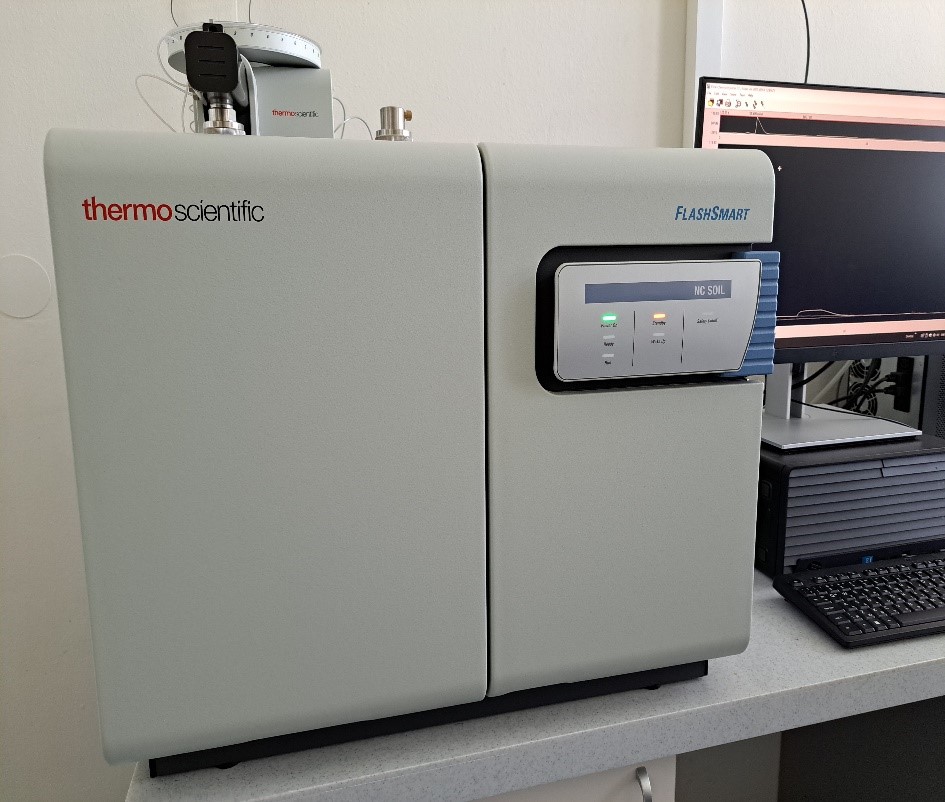
The FlashSmart elemental analyzer measures the carbon, hydrogen, nitrogen and sulfur contents of solid or liquid samples in a single measurement, and for purely organic samples, oxygen can be calculated as the difference to 100% or measured with a separate additive. It is characterized by the lack of need for chemical sample preparation, speed and low levels of detection. For the analysis of rocks, coal and oil, about 0.003 grams of sample are usually required.
The X-ray diffractometer is used for studying crystal structures and for diagnosing various types of materials – natural and anthropogenic minerals, rocks, ores, concentrates, soils, construction materials, wastes (mining and technological), and others. It has a wide range of applications in solving practical tasks related to the exploration, extraction, and processing of mineral and energy resources.
The equipment enables the analysis of the chemical composition of solid samples using EDS analysis, as well as electron microscopy imaging of specimens at high magnifications.
The inductively coupled plasma atomic emission spectrometer (ICP–AES) is a highly sensitive analytical instrument used for qualitative and quantitative determination of the chemical composition of samples – most often for the content of trace elements and impurities. The method employs plasma at very high temperatures to excite atoms and ions, and the emitted light is analyzed spectrally.

Approved by Council of Ministers Decision No. 508/18.06.2024 and financed by the Ministry of Education and Science (Agreement No. DO1-206/08.11.2024)


+359 2 8723563
